
Chinese chives: sowing and growing
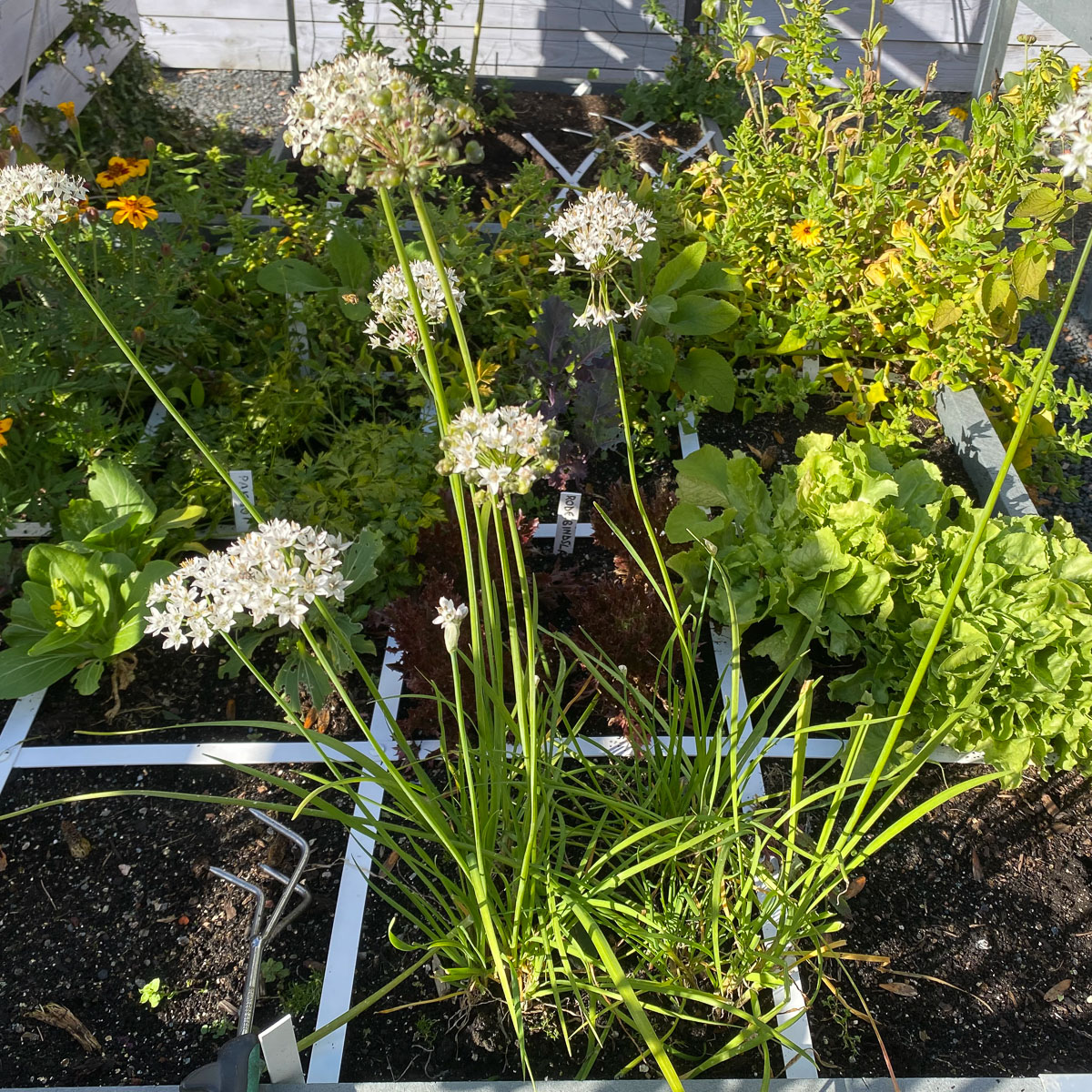
Chinese chives, also called garlic chives, are perennial and cold-hardy. Their flat leaves taste of garlic and their white flowers attract plenty of bees and butterflies.
What are Chinese chives?
Chinese chives, or garlic chives, have flat leaves with a fairly strong garlic flavour. They take time to become substantial plants, but once established you can enjoy them year after year.
Start the seeds on a windowsill in March, or sow them directly outside from April in a Makkelijke Moestuin raised bed or MM-mini.
The plant tolerates cold and returns each spring. It has few problems with pests or diseases and needs little more than water.
Start the seeds on a windowsill in March, or sow them directly outside from April in a Makkelijke Moestuin raised bed or MM-mini.
The plant tolerates cold and returns each spring. It has few problems with pests or diseases and needs little more than water.
Chinese chives as a traditional herb
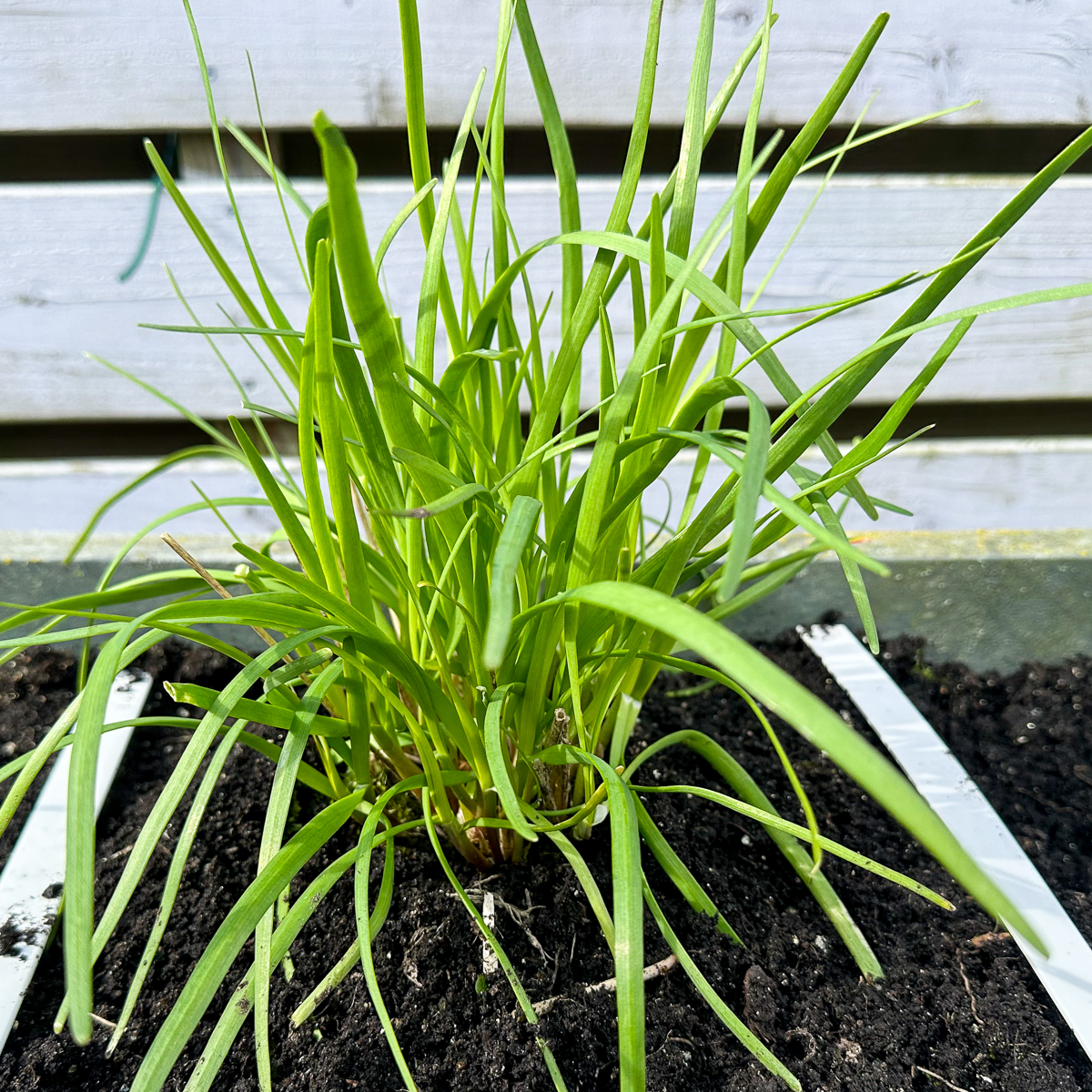
Chinese chives have been valued in Asian cooking and traditional practices for centuries.
The leaves provide fibre, vitamins and minerals, and add a fresh garlic flavour to food. Use them as a culinary herb rather than as a replacement for medical care.
The leaves provide fibre, vitamins and minerals, and add a fresh garlic flavour to food. Use them as a culinary herb rather than as a replacement for medical care.
More about Makkelijke Moestuin Chinese chive seeds
Unlike ordinary chives, Chinese chives have flatter, slightly tougher leaves that taste of garlic rather than onion.
The seeds take time to germinate and you need patience before the first harvest, but the plants then return every year.
The white flowers are beautiful too, even pretty enough for a small vase.
To harvest during the first year, start the seeds indoors in March and plant them in the raised bed as young plants. You can sow directly outside from April, but the plants will really come into their own the following year.
The seeds take time to germinate and you need patience before the first harvest, but the plants then return every year.
The white flowers are beautiful too, even pretty enough for a small vase.
To harvest during the first year, start the seeds indoors in March and plant them in the raised bed as young plants. You can sow directly outside from April, but the plants will really come into their own the following year.
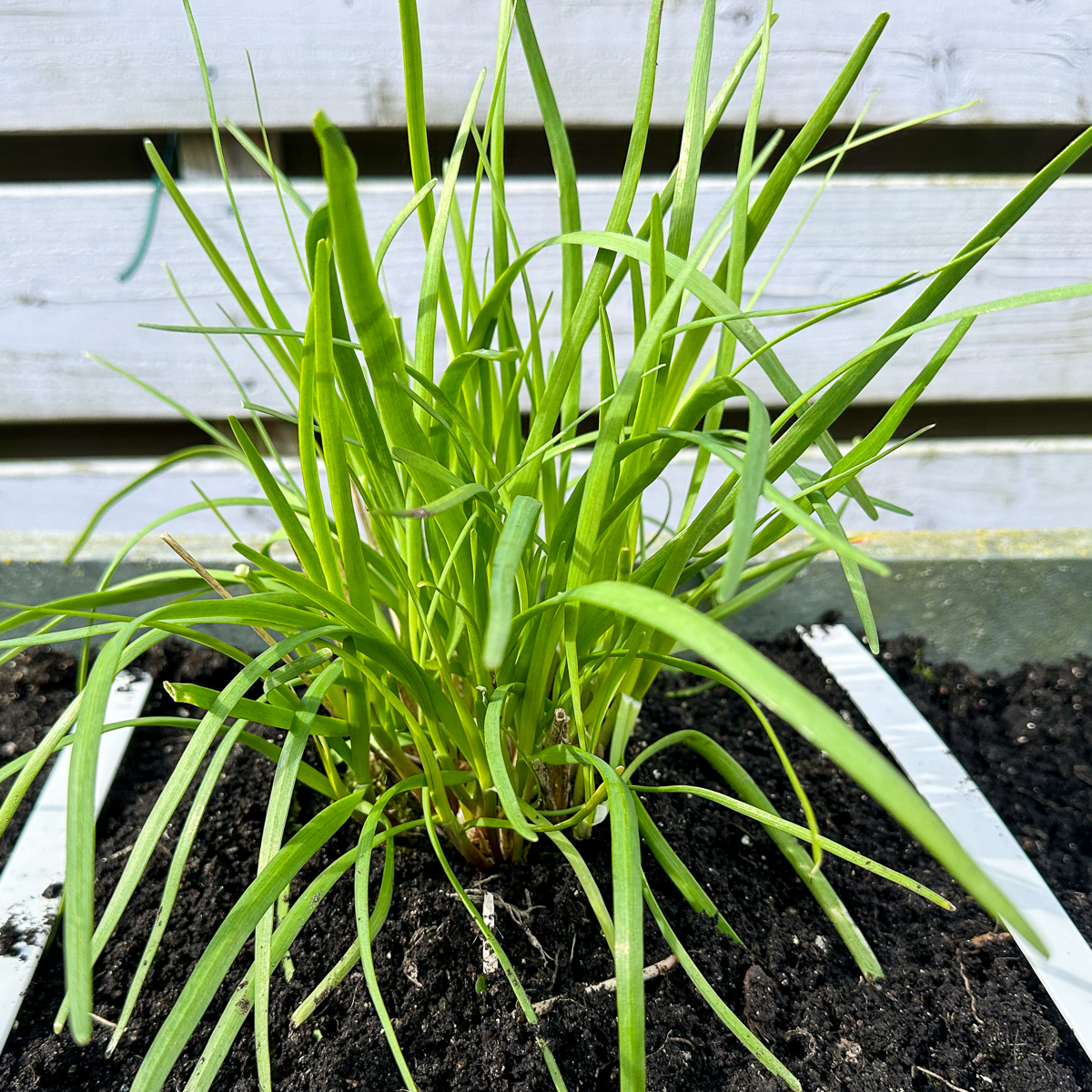
To harvest in the same year, start the plants indoors first. The app gives you instructions for doing this in March.
- Variety: Chinese chives
- Family: onion, root
- Plants per square: four clumps
- Height: 25 to 40 cm
- Start indoors: March
- Sow directly outside: April to August
- Sowing depth: 0 cm, on top of the mix
- Germination: 15 to 30 days from 18°C
- Time to harvest: from 15 weeks
- Sunlight: preferably sun, but shade is possible
Want to buy Chinese chive seeds? Find the packets in the seed shop.
What do you need to grow Chinese chives?
Chinese chives can be difficult to germinate and the seedlings grow very slowly at first, so start them indoors.
Besides the seeds, you will need:
- four small MM-Airpots
- MM coconut seed-starting mix
- one label for each pot
Once the plants are large enough to go outside, you will need:
- one 30 x 30 cm square
- Makkelijke Moestuinmix or MM coconut mix
- a place with six to eight hours of sunlight each day
How do you sow and grow Chinese chives?
Chinese chives are included in the free Makkelijke Moestuin app. Use it and you will get step-by-step guidance from seed to harvest.
Every vegetable goes through several stages, which we call levels. The app tells you exactly what to do at each level and regularly asks you to check whether your plants are ready for the next one.
You do not need to know how to raise Chinese chives successfully before you start. But if you would like to read ahead, here is what the whole process looks like.
Every vegetable goes through several stages, which we call levels. The app tells you exactly what to do at each level and regularly asks you to check whether your plants are ready for the next one.
You do not need to know how to raise Chinese chives successfully before you start. But if you would like to read ahead, here is what the whole process looks like.
Level 1: Start Chinese chives indoors
Raising Chinese chives from seed to harvestable plants takes quite a long time, especially outside.
Start them indoors, move the pots to a protected place outside, and only give the clumps their own square once they are larger.
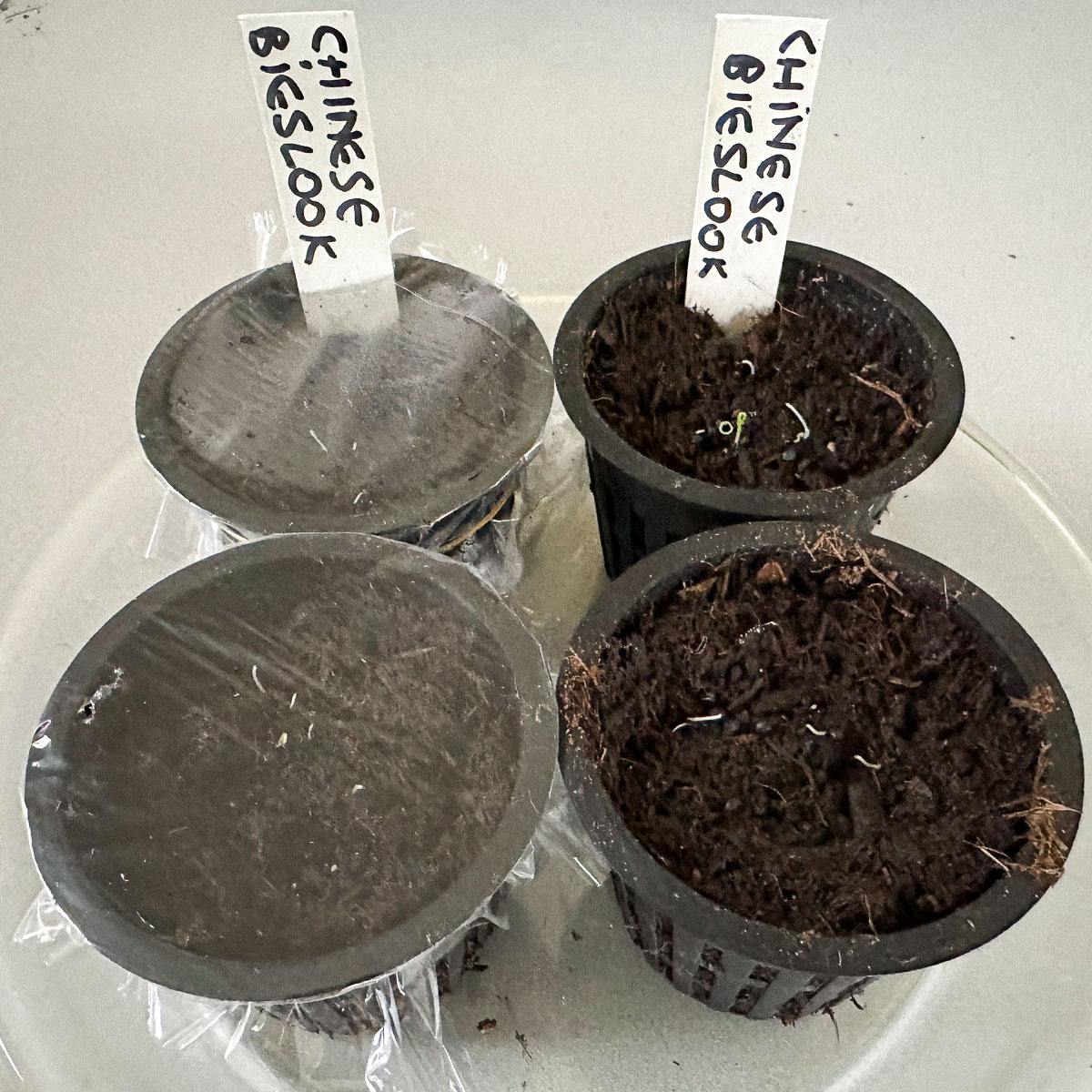
Use four small Airpots filled with moist seed-starting mix. Place 10 to 12 seeds on top of the mix in each pot. They can be close together. Press them down gently but do not cover them: they need light to germinate.
Start them indoors, move the pots to a protected place outside, and only give the clumps their own square once they are larger.
Use four small Airpots filled with moist seed-starting mix. Place 10 to 12 seeds on top of the mix in each pot. They can be close together. Press them down gently but do not cover them: they need light to germinate.
Levels 2 and 3: Move the pots outside
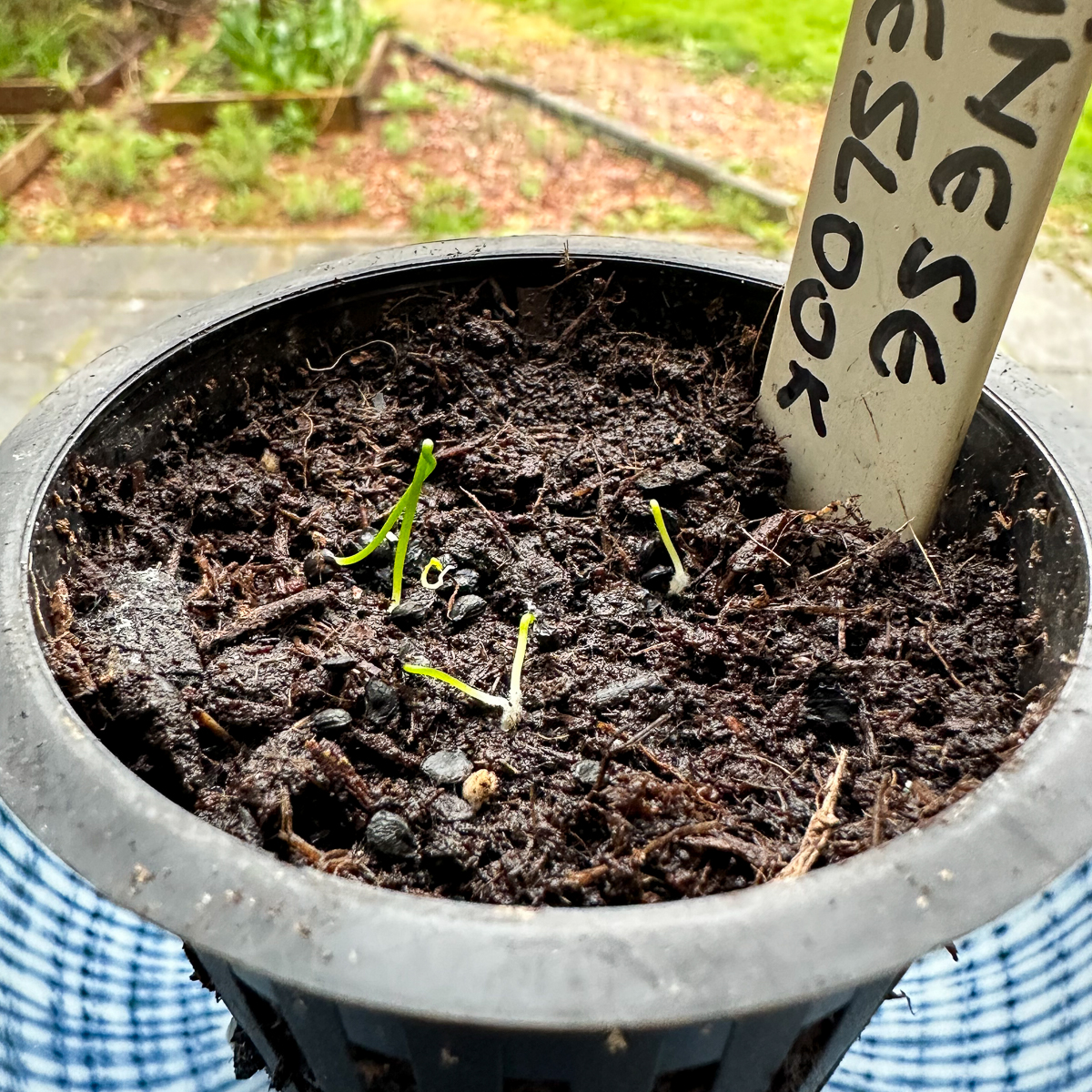
Remove any covering as soon as the first fine shoots appear, usually after two to three weeks.
They will not all emerge at once, and some may not germinate, but more shoots will appear over the following weeks.
Once they are about the size shown below, move the pots outside. Put them together in an empty square or MM-mini; there is easily room for nine pots.
They will not all emerge at once, and some may not germinate, but more shoots will appear over the following weeks.
Once they are about the size shown below, move the pots outside. Put them together in an empty square or MM-mini; there is easily room for nine pots.
Level 4: Plant into their own square
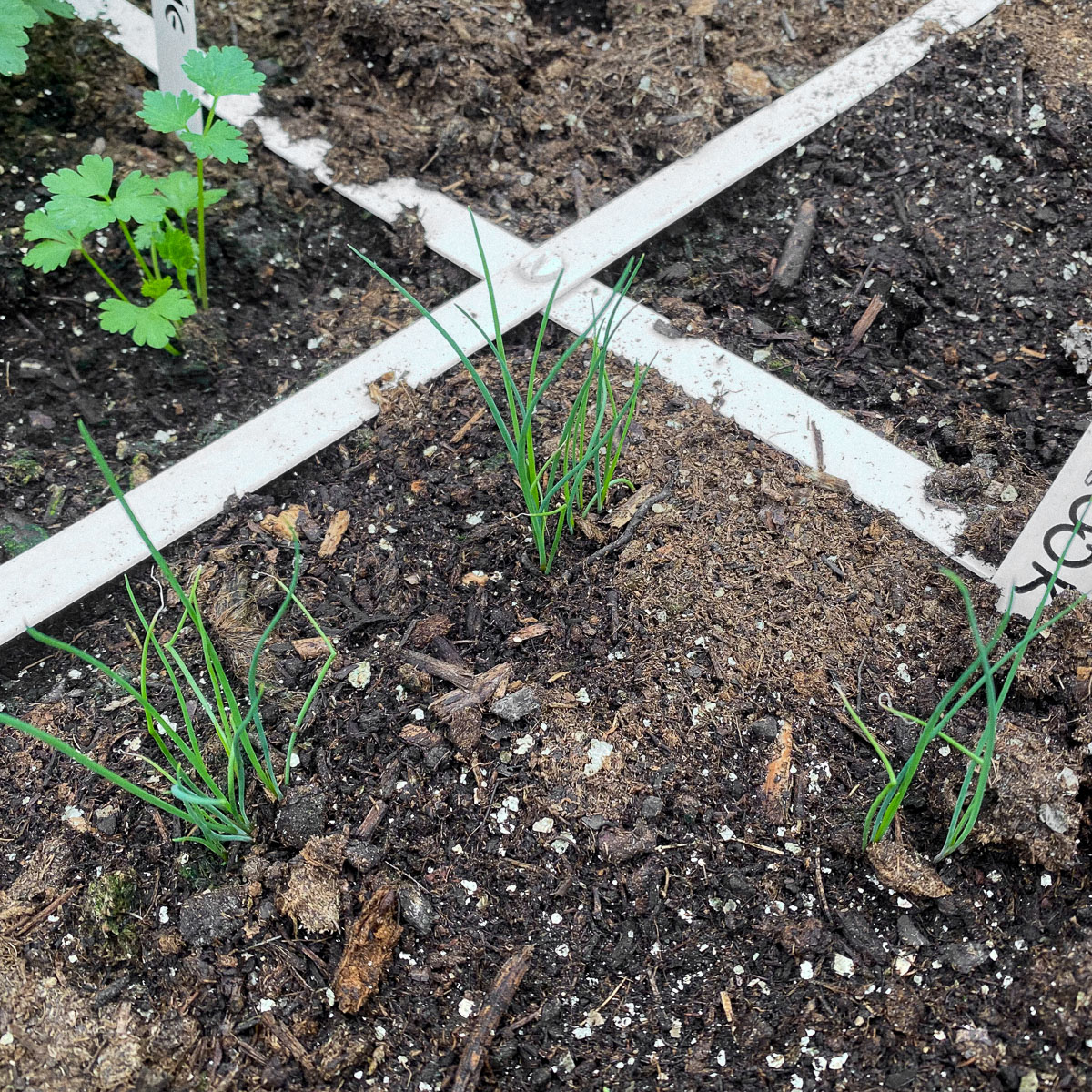
Chinese chives tolerate cold well, so there is no need to harden them off before planting outside.
Four clumps fit in one square.
From this point, the plants need very little attention and grow largely by themselves.
Water regularly during dry weather.
Four clumps fit in one square.
From this point, the plants need very little attention and grow largely by themselves.
Water regularly during dry weather.
Levels 5 and 6: Harvest leaves and manage flower stems
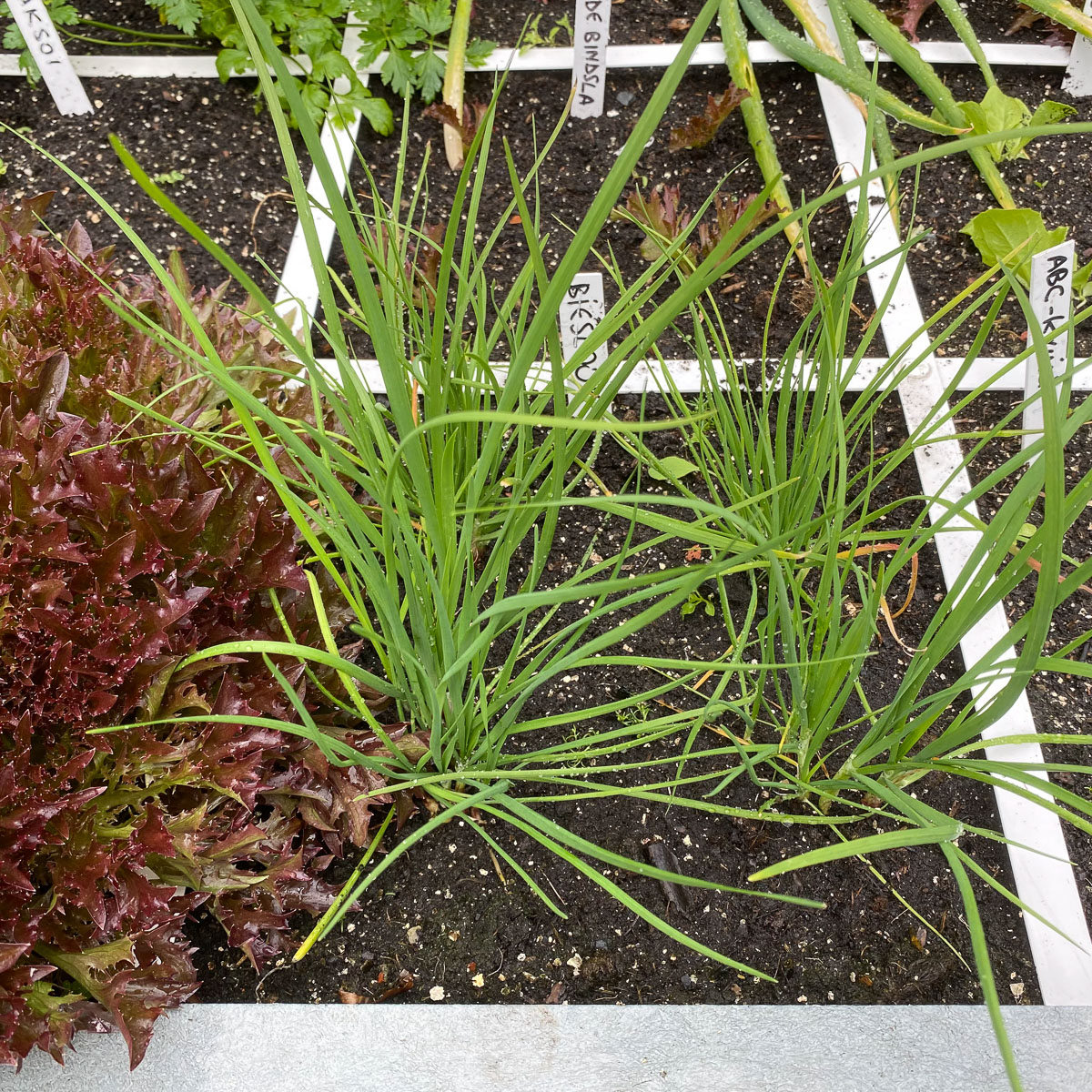
Around 10 weeks after planting out, the plants are ready to pick.
Cut or pick some leaves about 2 cm above the mix. New leaves will continue to grow.
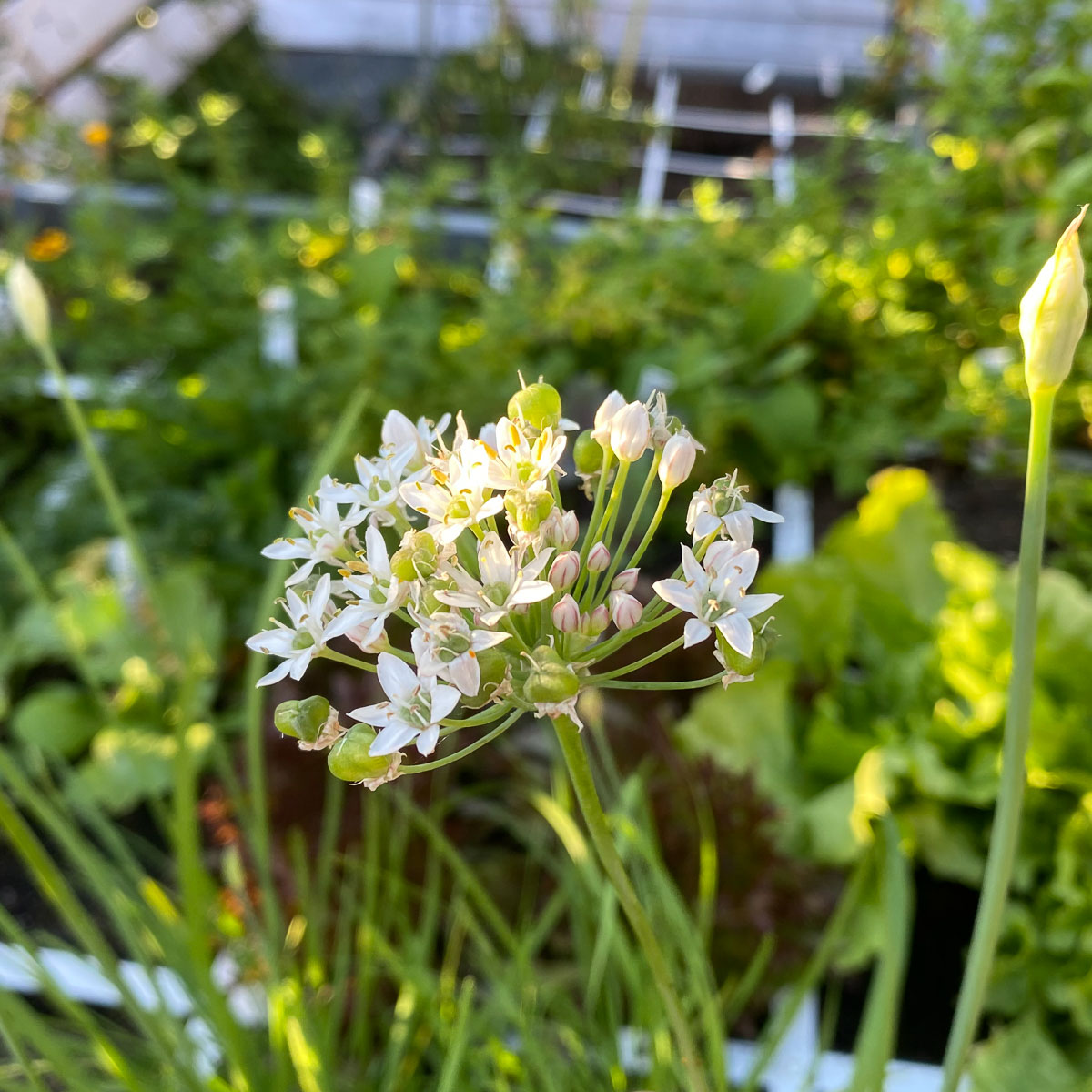
The plants will eventually flower. The buds and flowers are edible too, but the leaves have the best flavour.
Remove most flower stems if you want the largest possible leaf harvest. The flowers are beautiful, however, and attract many bees and butterflies.
You can continue harvesting leaves until it becomes properly cold, usually around November.
Cut or pick some leaves about 2 cm above the mix. New leaves will continue to grow.
The plants will eventually flower. The buds and flowers are edible too, but the leaves have the best flavour.
Remove most flower stems if you want the largest possible leaf harvest. The flowers are beautiful, however, and attract many bees and butterflies.
You can continue harvesting leaves until it becomes properly cold, usually around November.
The plants will eventually flower. The buds and flowers are edible too, but the leaves have the best flavour.
Remove most flower stems if you want the largest possible leaf harvest. The flowers are beautiful, however, and attract many bees and butterflies.
Remove most flower stems if you want the largest possible leaf harvest. The flowers are beautiful, however, and attract many bees and butterflies.
How do you use Chinese chives?
The leaves are delicious in soup, omelettes, stir-fries and pasta. They taste like garlic, but are slightly milder. Add them at the very end, as cooking quickly reduces their garlic flavour.
Finely chopped raw leaves are also good in salads, cold garlic sauce or garlic butter.
The flowers are edible too, although they are tougher and milder. In China, the flower buds are more commonly used, especially in stir-fries and noodle soup.
Finely chopped raw leaves are also good in salads, cold garlic sauce or garlic butter.
The flowers are edible too, although they are tougher and milder. In China, the flower buds are more commonly used, especially in stir-fries and noodle soup.
Level 7: Winter dormancy
At the end of the season, the plants decline: the leaves wither and turn yellow. If you left the flowers, they will now have dried and you can collect the seeds if you wish.
Once it becomes properly cold, the growth above ground dies back. The plants return in early spring, grow faster and give you a much earlier harvest.
Once it becomes properly cold, the growth above ground dies back. The plants return in early spring, grow faster and give you a much earlier harvest.
Level 8: The second season
In a mild spring, the first shoots can appear around mid-February.
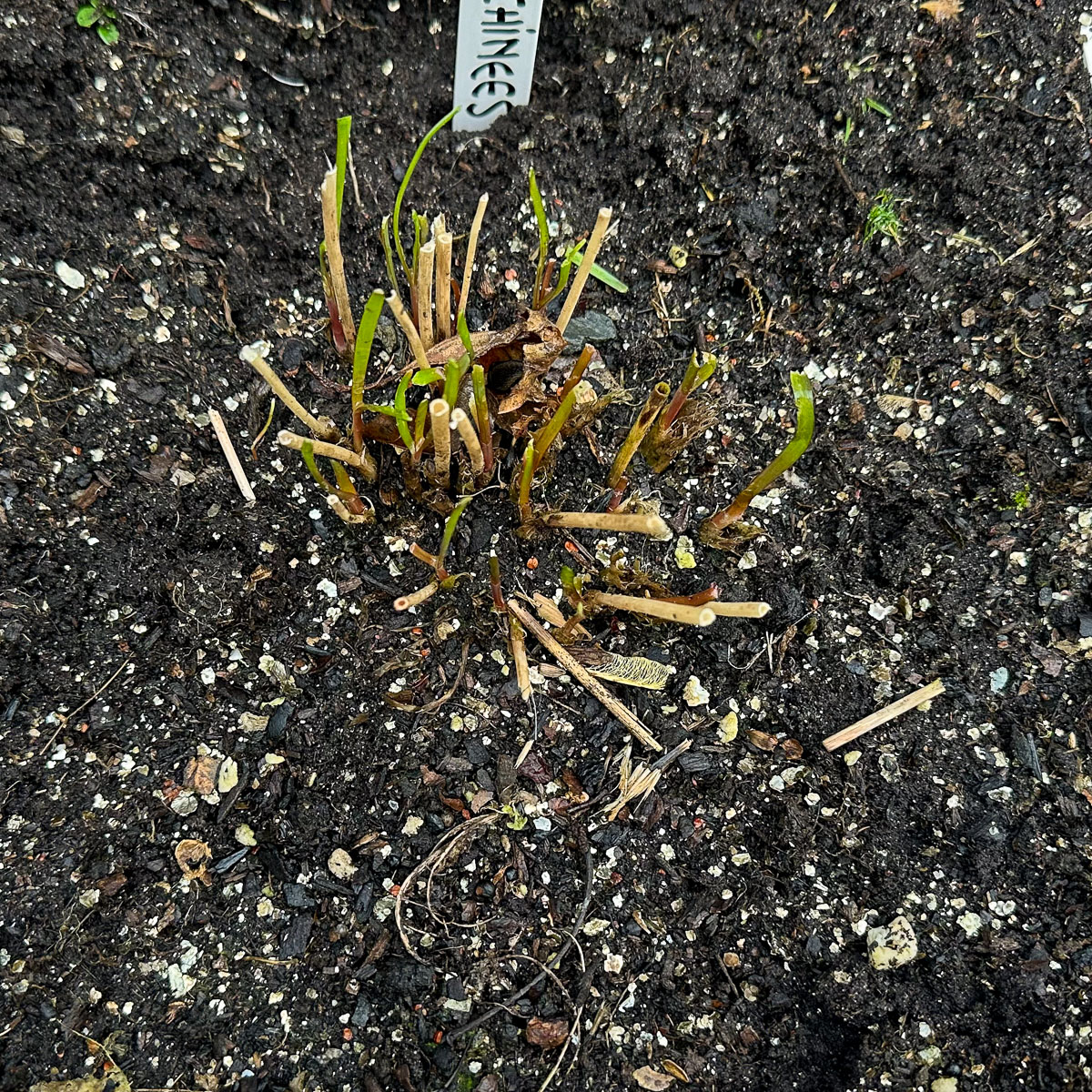
The plants now grow faster than they did last year, so you can harvest much earlier.
Sprinkle two tablespoons of MM plant food around the plants and lightly rake it into the surface.
More stems appear each year and the clumps become larger. After the second year, divide and replant them every two to three years, preferably in a different square.
Care remains easy: water during dry weather and do little else. The app therefore sends no further reminders.
Sprinkle two tablespoons of MM plant food around the plants and lightly rake it into the surface.
More stems appear each year and the clumps become larger. After the second year, divide and replant them every two to three years, preferably in a different square.
Care remains easy: water during dry weather and do little else. The app therefore sends no further reminders.
So, what is stopping you from growing Chinese chives?
They are a delicious herb. You need some patience before the first harvest, but can then enjoy them year after year. With our app and materials, it is almost impossible to fail.
Good luck, and enjoy!