
A growing mix all your plants thrive in
In a Makkelijke Moestuin, you don't use your garden soil or just any potting compost, but a special growing mix. It gives all your plants what they need, stays light and airy, holds nutrients and moisture well, and never needs replacing.
On the previous page about how our raised beds work, I explained that we fill them with a special growing mix.
Why? Let me explain:
Why? Let me explain:
Plants only thrive in the right soil
The secret to a successful vegetable garden is the soil. The better the soil, the better your vegetables grow, because that's where plants get their nutrients and moisture, as well as air for their roots.
That's why gardeners with a traditional vegetable garden spend most of their time improving the soil, as well as weeding.
Professional growers create a separate soil mixture for each type of plant, with the right acidity (pH), nutrients and moisture balance, and replace it after every crop.
People who simply throw standard potting compost into a container, on the other hand, achieve hardly any results and usually give up again quite quickly.
People who simply throw standard potting compost into a container, on the other hand, achieve hardly any results and usually give up again quite quickly.
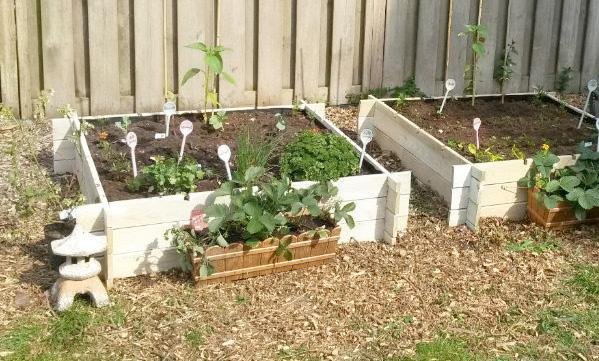
So we do things differently. We grow in raised beds and fill them with a growing mix developed specially for our system. It's suitable for every plant you put in your raised bed, only needs an occasional top-up of plant food, and never needs replacing.
That gives you real results, without lots of work or repeatedly replacing the soil.
About our growing mix
Holds water, air and nutrients well
This means plants don't need to produce large roots to find nutrients and moisture, and a layer just 20 cm deep is enough, even if it settles a little during the season.
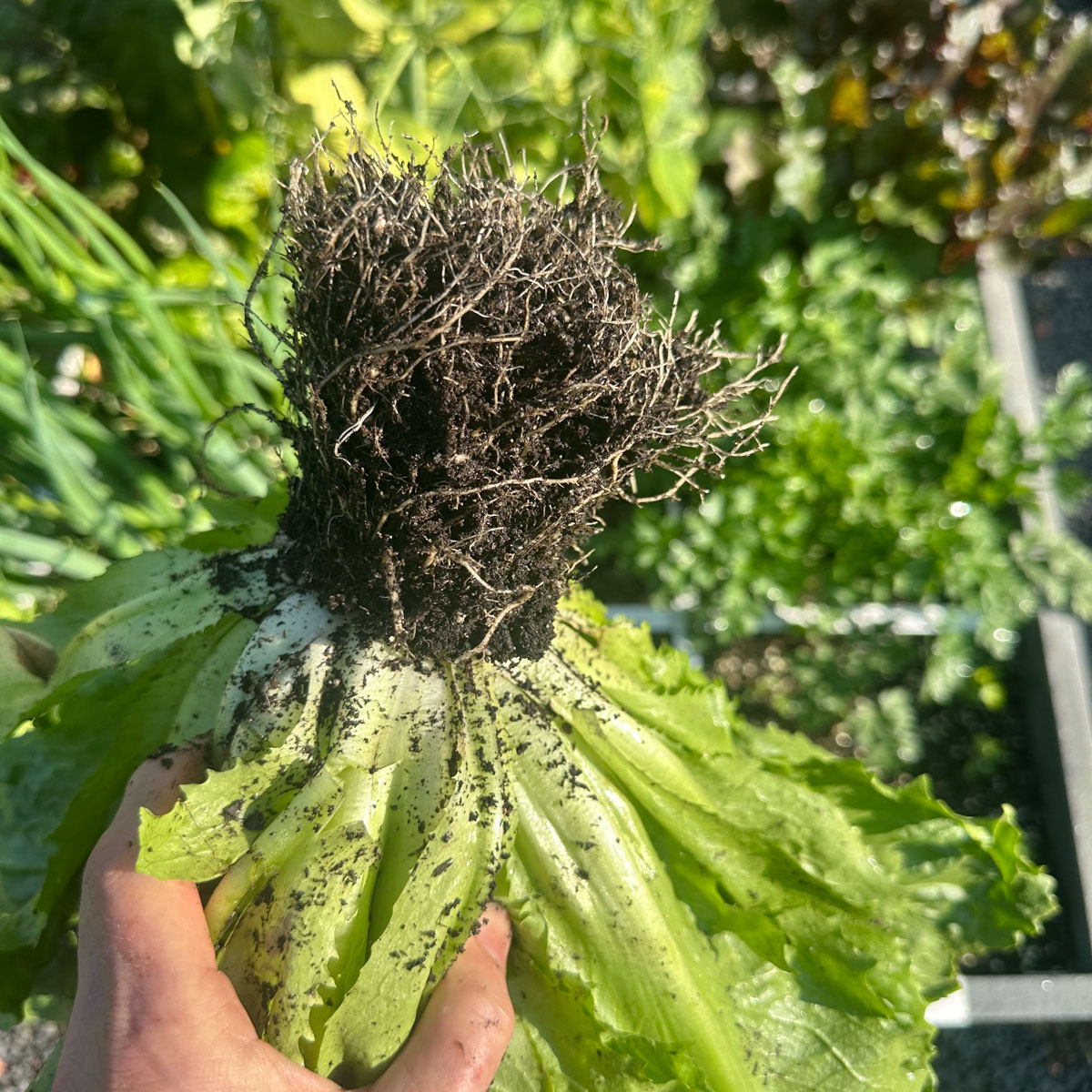
Because the mix holds water well, it stays exactly where it's needed: around the roots of your plant. At the same time, the mix can never become too wet.
Think of it like a sponge: it absorbs moisture until it's saturated, and any excess water drains away.
Think of it like a sponge: it absorbs moisture until it's saturated, and any excess water drains away.
Easy to maintain
Our mix contains only long-lasting ingredients. All you need to do is add a little plant food occasionally and top up the mix after a year or so.
That's good for the environment and kind to your wallet.
That's good for the environment and kind to your wallet.
Suitable for all plants
Because you'll grow all kinds of different vegetables in one Makkelijke Moestuin raised bed, the growing mix is suitable for every plant: heads of lettuce, beans and tomatoes. You'll never need to wonder whether your soil suits your vegetables 😊
That's because our mix contains balanced plant food that every variety thrives on, works for a long time, and works in every season.
That last point sounds obvious, but it isn't. Compost releases hardly any nutrients in cold, rainy weather, while artificial fertiliser - which we don't use anyway - is exhausted very quickly.
Reliable
If you know your growing mix is good but your plants still aren't growing as well as expected, you can immediately look for another cause, such as pests or bad weather.
100% sustainable and organic
Come on: you don't start a vegetable garden to pollute the world with chemical rubbish, do you?
Free from diseases, weed seeds and roots
Start with a clean mix and you'll have hardly any trouble from diseases or weeds. Anything that does find its way in later is easy to keep under control.
Wat zit er in onze moestuingrond?
Momenteel verkopen we 2 soorten:
- De Makkelijke Moestuingrond: deze grond bestaat voor het grootste deel uit kokos, aangevuld met voeding en wormencompost en is speciaal ontwikkeld voor gebruik in onze moestuinbakken met waterreservoirs.
- De klassieke Makkelijke Moestuinmix: deze grond bestaat uit compost, vezels (zoals van bruinveen, cocopeat en houtvezels) en aanvullende voedingsstoffen. Geschikt voor alle bakken en potten, maar iets minder voor gebruik bij waterreservoirs.
Ik begin met de eerste:
New: MM-kokosmix for water reservoirs
If you've followed us for a while, you'll know that we keep testing, even when something already works very well. Last year, we did that with MM-mix, specifically for use with our new water reservoirs.
We discovered that coconut fibres draw water up through the wicks much faster and more consistently than brown peat fibres, even after they've dried out completely. So we continued developing the idea.
After extensive testing, we arrived at MM-kokosmix, tailored completely to our raised beds with water reservoirs and to our system.
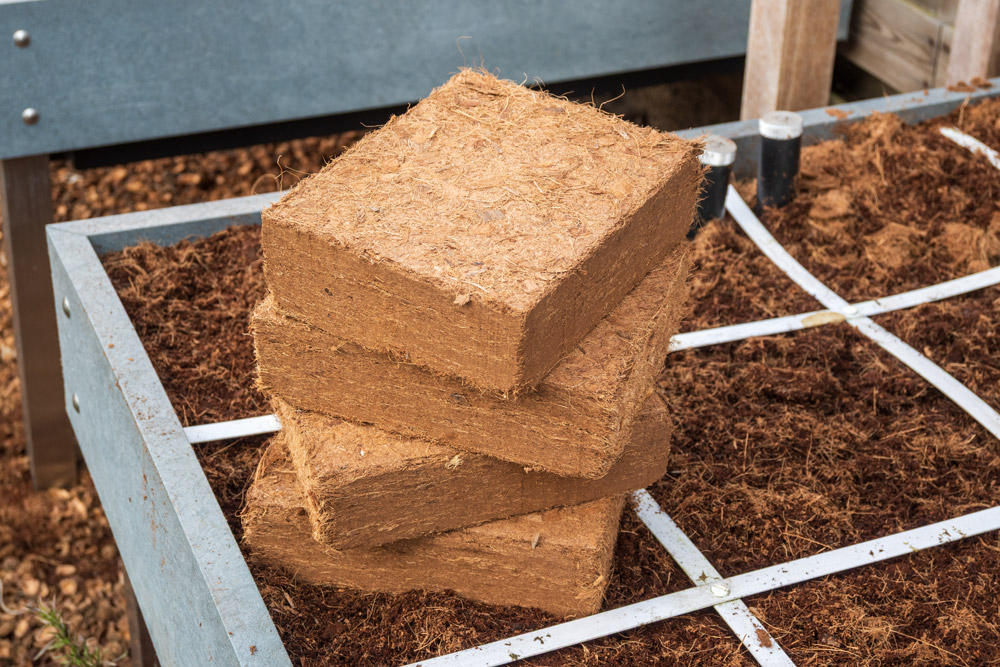
What's in this coconut mix, and where does it come from?
- We use a mixture of fairly coarse, dust-free coconut fibres and pieces of coconut husk. This keeps the mix light and allows it to absorb exactly enough water.
- We wash and buffer the fibres so the pH (acidity) is between 6.5 and 7 and the EC value (salt level) is low.
- We source the mix from long-established family businesses in India and Sri Lanka that care about their staff and the environment.
- The mix has RHP certification. An independent organisation checked its quality, safety and reliability: no contaminants, no weed seeds, and a consistent composition. We also had it tested again by an independent Dutch organisation.
- We supply the mix as compressed blocks. They're compact, much lighter than bags of loose mix, and take up less space.
Please note: coconut fibres are naturally low in nutrients. To create a nutritious mix, you must first add Makkelijke Moestuinvoeding. The resulting MM-kokosmix is suitable for all the vegetables, herbs and flowers you put in your raised bed, just like MM-mix.
What's in our growing mix?
Our standard Makkelijke Moestuinmix combines ingredients that complement one another perfectly: green compost; peat, wood and coconut fibres; pieces of bark; and organic nutrients.
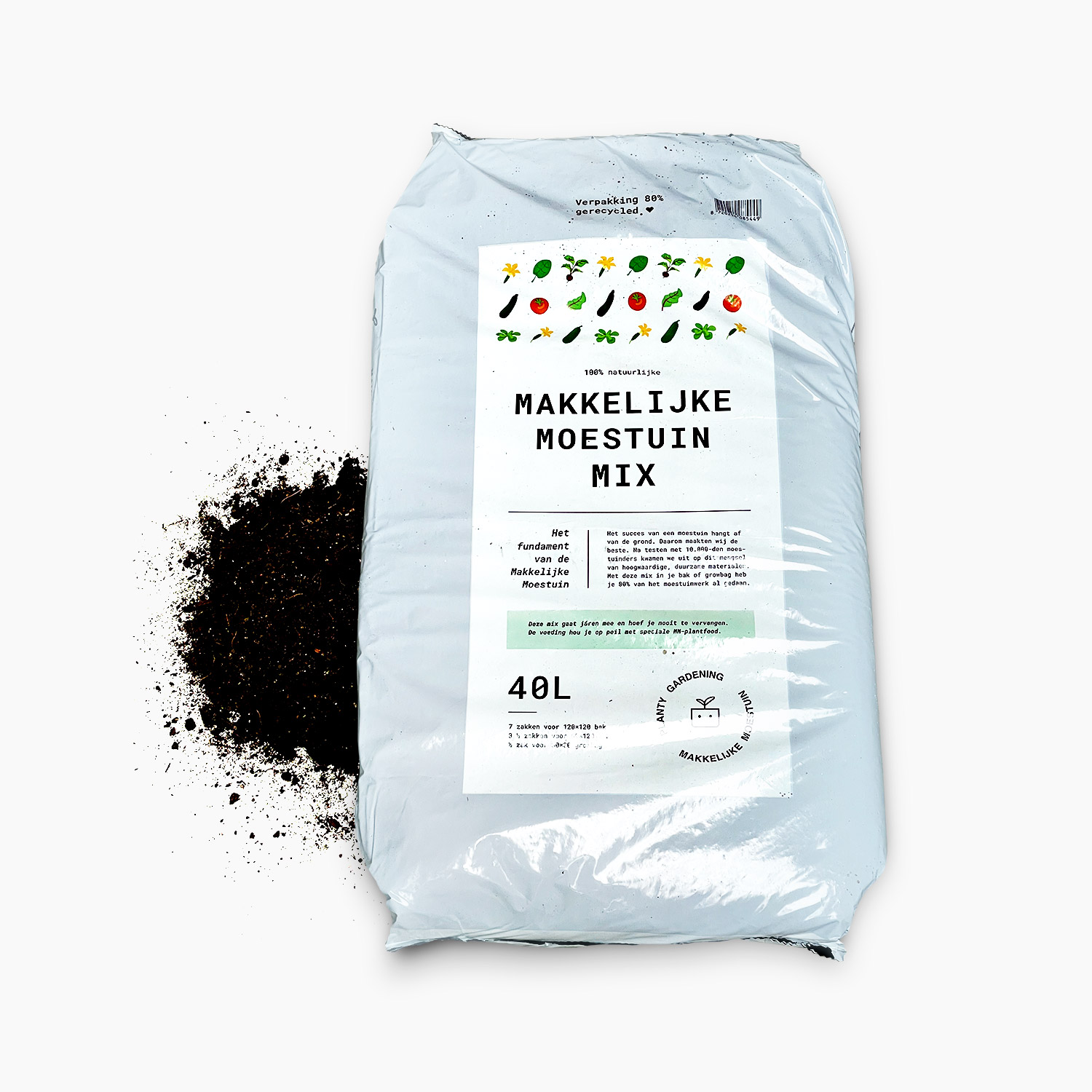
Green compost: the dark material left behind when plants decompose. Its average pH is fairly high, between 6 and 7. That's alkaline: the opposite of acidic. It contains nutrients and minerals and also retains a reasonable amount of moisture.
Brown peat: fibres from raised bogs, which are thick layers of undecomposed plant remains, mainly sphagnum moss - better known as peat. Brown peat is the upper layer that regrows most quickly. It's medium brown, lasts a long time, and has a low pH of 3.5 to 4.5, which means it makes the soil slightly acidic.
Coconut fibres: these come from coconut husks. They absorb water easily and retain it well. Their pH is as alkaline as that of compost.
Brown peat: fibres from raised bogs, which are thick layers of undecomposed plant remains, mainly sphagnum moss - better known as peat. Brown peat is the upper layer that regrows most quickly. It's medium brown, lasts a long time, and has a low pH of 3.5 to 4.5, which means it makes the soil slightly acidic.
Coconut fibres: these come from coconut husks. They absorb water easily and retain it well. Their pH is as alkaline as that of compost.
Wood fibres: these have the same properties as brown peat.
Pieces of tree bark: added to keep the mix light and loose.
Plant food: this is 100% natural and precisely tailored to our system. It contains more than 15 different natural raw materials, many of them plant-based.
Het resultaat van beide soorten moestuingrond
Those fibres retain moisture extremely well while keeping the mixture light and loose. The compost and other additions provide the nutrients.
Each ingredient is already a good material with useful properties. Combine them, however, and you get a growing mix with an acidity level in which almost every vegetable thrives.
That's why my tomatoes do just as well as my heads of lettuce and French beans.
Okay, I admit that a professional grower will produce larger pumpkins than I do, but mine still look pretty good:
Okay, I admit that a professional grower will produce larger pumpkins than I do, but mine still look pretty good:

Which is better: standard MM-mix or MM-kokosmix?
Neither is better than the other. They work equally well, including in raised beds with a water reservoir. It makes no difference to your plants; the difference is mainly for you.
For raised beds without a reservoir, we still use MM-mix. We're still extremely happy with it.
For new raised beds with a reservoir - ones you still need to fill - we now recommend MM-kokosmix, simply because it continues to draw water from the reservoir a little more evenly during summer. It even does so after drying out completely because you forgot to refill the reservoir once 🙂
For raised beds without a reservoir, we still use MM-mix. We're still extremely happy with it.
For new raised beds with a reservoir - ones you still need to fill - we now recommend MM-kokosmix, simply because it continues to draw water from the reservoir a little more evenly during summer. It even does so after drying out completely because you forgot to refill the reservoir once 🙂
For raised beds with a reservoir that are already filled
If you've had one for a while and it currently contains MM-mix supplemented with perlite, you don't need to change anything. It works just as well. The only difference is that this mix dries out from the top a little faster in summer. In that case, wet it thoroughly from above with a watering can or container of water before it starts drawing water upwards again.
So, now you know what the mix is
Next, we'll move on to the water reservoir. What exactly is it, and how does it work?